
The Processing Loop
THE SOUTAR SCHEMA
The Processing Loop
How the system detects, evaluates, and responds — before conscious thought gets involved
What the processing loop is
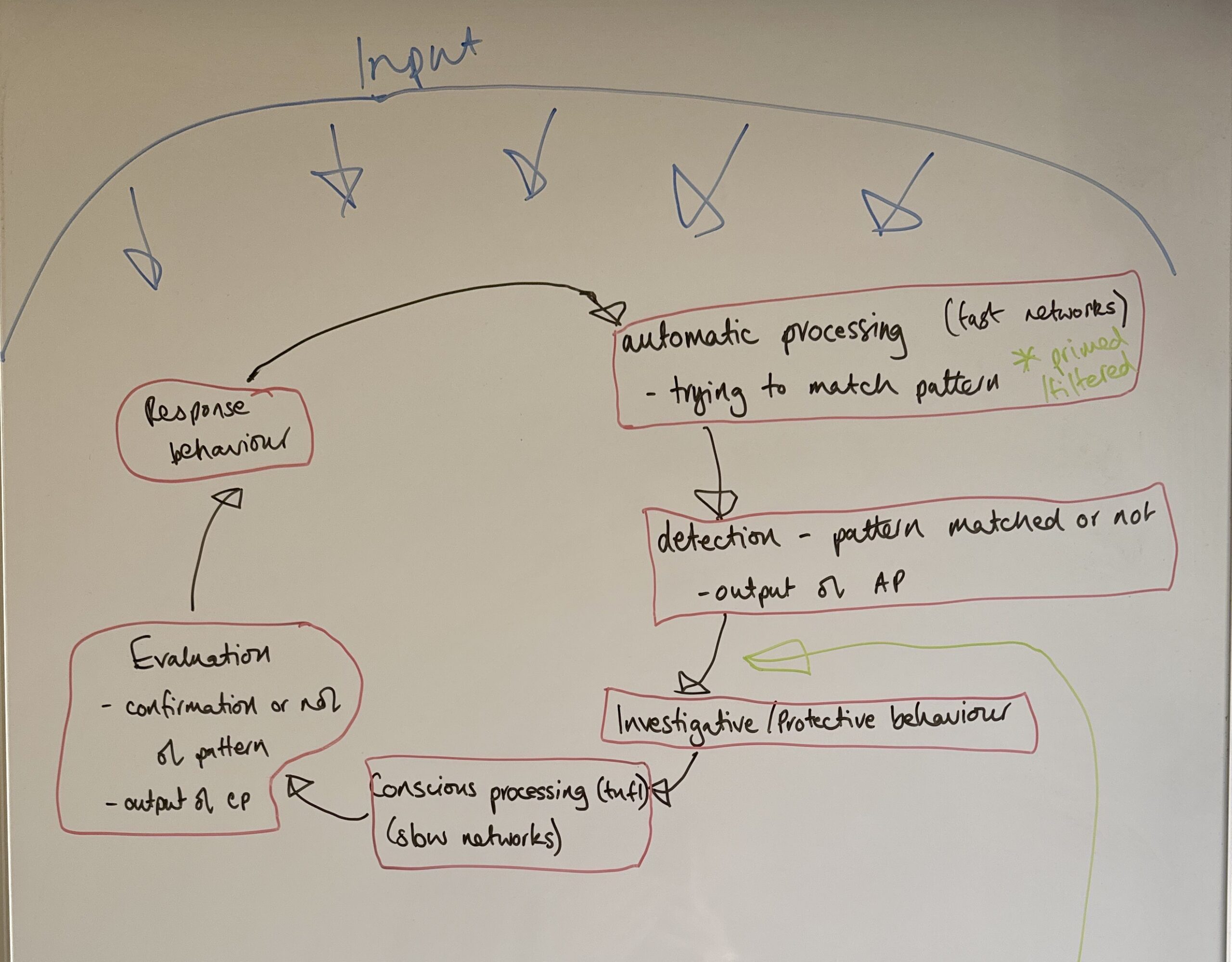
The human system processes continuously. Inputs arrive constantly — not at a single entry point, but across the whole loop, at every stage, all the time.
The loop runs at two speeds.
Fast processing operates automatically — pattern-matching against everything the system has encountered before, filtered and primed by history and experience. It doesn't wait for conscious attention. It's already running.
Slow processing operates deliberately — evaluating what fast processing has flagged, forming a considered response. It works with what fast processing passes through.
The two speeds aren't sequential. They're concurrent — fast processing is always active, slow processing engages when something warrants it.
Priming and filtering
Fast processing doesn't detect everything equally. It is primed — configured by experience, history, and what the system has learned to treat as significant — to notice certain things and not others.
What the system is primed to detect gets flagged and routed forward. What falls outside that range passes through unnoticed — not because it isn't there, but because no part of the system has been configured to pick it up.
This filtering is functional. Without it, the system would be overwhelmed by everything simultaneously.
It is also a source of systematic blind spots. Things that consistently pass undetected — not because they're unimportant, but because the system hasn't been configured to notice them yet.
The pattern blueprints in the reference library show what specific signals look like when they do get detected — and what they're pointing to.
What shapes the priming
The filters aren't chosen consciously. They're configured by:
— What the system has learned to treat as threat or safety
— What has historically been significant or irrelevant
— The current state of the system
— load, activation, available capacity
— Settled interpretations and axioms the system operates from
The same input can be detected or missed depending on the state the system is in when it arrives.
What the loop produces
The output of the processing loop is behaviour — the system's response to what it has detected, evaluated, and decided to act on.
Behaviour is always downstream of the loop. Changing behaviour directly is working on the output. Understanding the loop — what it's primed to detect, what it's systematically missing, what shapes its current configuration — is working on the conditions.
What it connects to
The processing loop and Human Systems Accounting operate together. The loop determines what signals get detected and flagged. HSA models what the system does with those signals — how it calculates the cheapest available option from what it can see.
What the loop misses never reaches the ledger.
Helen Soutar
07855 306262