
The Soutar Model
The Soutar Model
The core architecture of the Soutar Schema
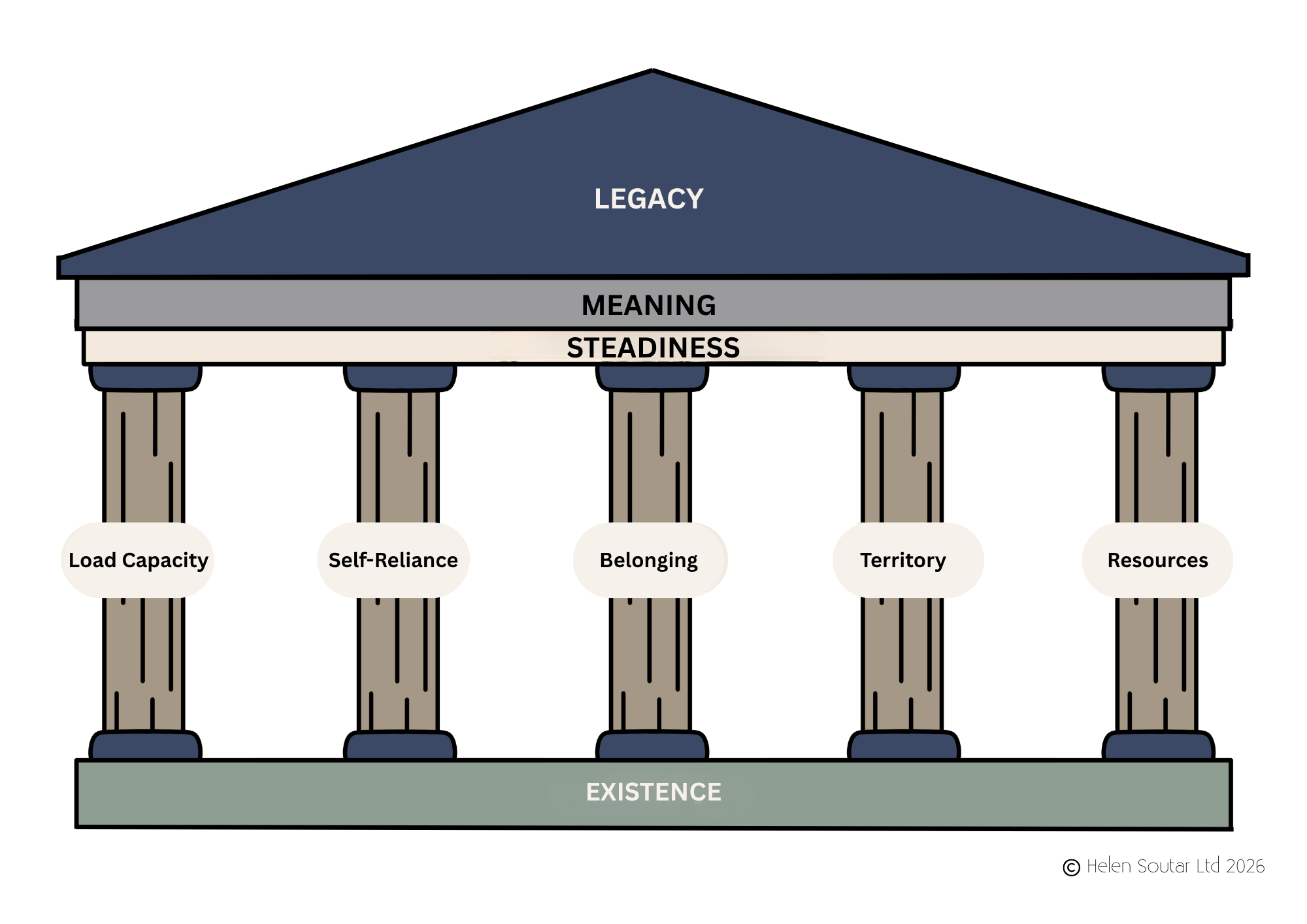
The model maps the human system in static form — a snapshot of what's present, how it's organised, and what depends on what.
At the base: existence. Being alive. Everything else rests on this.
Rising from it: five variables — load capacity, self-reliance, belonging, territory, resources. These are not personality traits or fixed characteristics. They are dynamic variables, each with a threshold range. Below the minimum, the system is under threat. Within range, the system functions. Above the maximum, distortion occurs.
When the variables are stable, steadiness emerges. Not as something worked toward directly, but as a natural consequence of the pillars holding.
Steadiness makes sustained meaning possible. Meaning, accumulated over time, becomes legacy.
The progression upward is not a ladder to climb. It is what the system produces when the conditions are right.
Working with the model
The model shows the architecture of the human system — what's present, how it's organised, and what depends on what.
Understanding that architecture is valuable in itself. It changes how you read what's happening — in yourself, in others, in organisations and systems at larger scale.
Each variable in the model maps directly to a capability — a set of learnable skills that can shift it.
Resilience → Load Capacity
Meta-Competence → Self-Reliance
Connection → Belonging
Agency → Territory
Resource Stewardship → Resources
Moving from understanding the model to working with it effectively is where the structured work begins. The bottleneck is rarely where it first appears, and locating it accurately requires understanding what the model is built on.
— for the fuller architecture and foundations the model sits within
— for the structured work that maps to each variable.
Helen Soutar
07855 306262